
I met Micaela Núñez through a concert series called Tres Paisajes Sonoros. I had never seen or heard her play, but something told me I had to go see her and interview her for the blog of How to Love Paraguay.
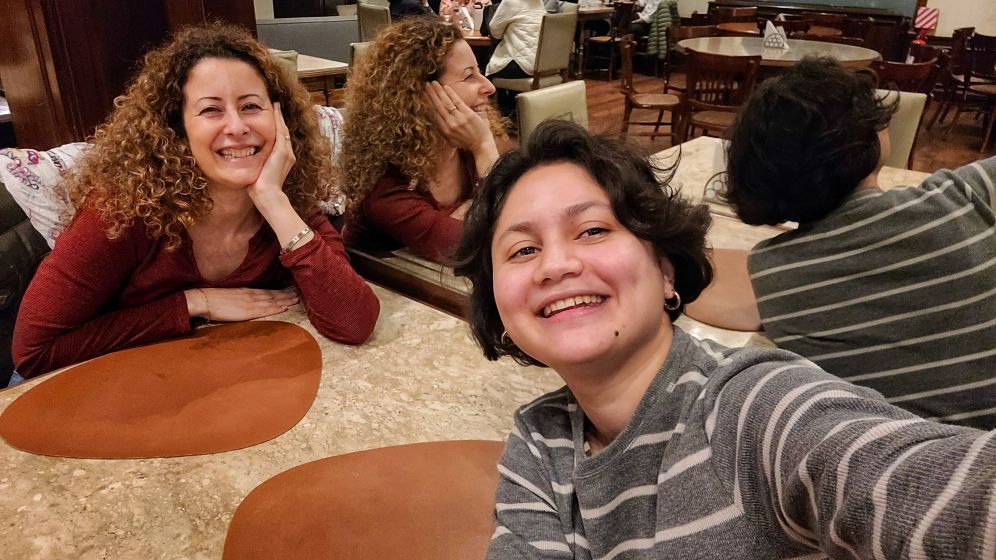
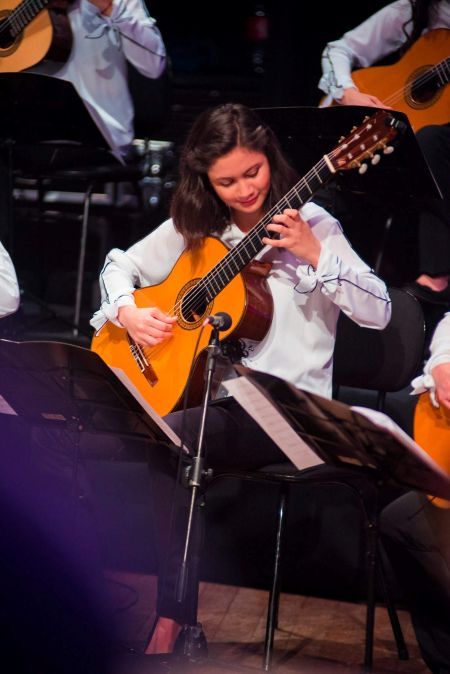
Watching the first concert confirmed what I suspected: Micaela Núñez is a guitar virtuoso, trained under the guidance of maestra Berta Rojas (so nothing can go wrong), and she has such skill in her hands that instead of fingers, she seems to have two little spiders playing and walking on the guitar strings.
Keep an eye out because this young and talented Paraguayan is coming on strong and you are going to hear about her a lot. Don’t leave without learning more about her and her upcoming concert at Ycua Bolaños.
Tell me in 5 lines about who Micaela Núñez is, the artist, and her background.
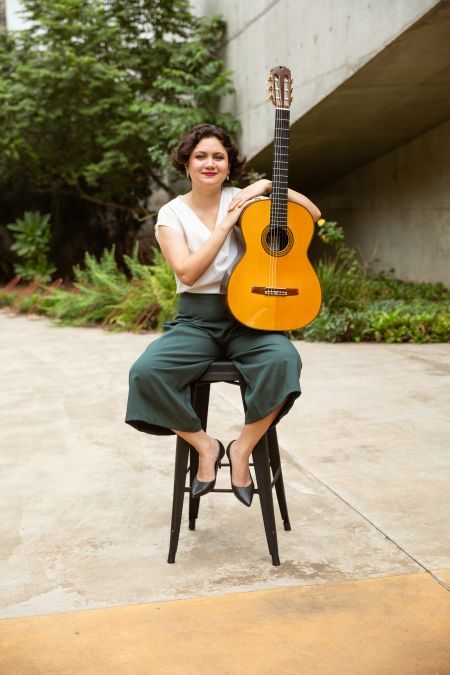
I am curious, a dreamer and passionate about music, nature, art in its many forms, and sharing it with those I love. On stage, I want to convey emotion through my performances. I graduated as a Classical Guitar Teacher, with a Bachelor’s degree in Music, and a diploma in Music Performance for Guitar.
When did you realise that you wanted to devote yourself to music and choose the Spanish/classical guitar as your companion?
The possibility of making a living from art was something I only decided when I was 16. I was already developing as a musician, but I had many fears and external prejudices that kept me from seeing music as a true profession.
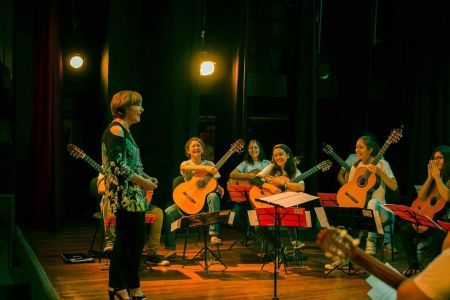
I clearly remember the moment when I told my parents that I wanted to pursue this career: it was a Sunday, after leaving a rehearsal for the Pu Rory Ensamble, a project run by maestra Berta Rojas.
I was so convinced and motivated that, as soon as they came to pick me up, and while we were still on the same block from the rehearsal space, I told them: “I want to study music at university.”
Still, I think that, subconsciously, the guitar was already my life partner. Since I began this path, I never spent much time away from it; it was a part of me everywhere I went, and many of my decisions had to do with my dream of continuing to play the guitar.
Who is a role model for someone as young as you. Do you follow many Instagrammers or Youtubers at your age?
My main role model was always—and still is—Berta Rojas. Even before I met her in person. I deeply admired her for her art, but that admiration grew even more when I discovered the person she is.
Today, I have several role models, and for the most part, I feel more represented by female performers. Among the guitarists I admire are Antigoni Goni, María Haro, Leonela Alejandro, Vera Danilina, Laura Snowden, among others.
In the realm of folklore, I have been deeply inspired by figures such as Mercedes Sosa, Chabuca Granda, and Violeta Parra.
The maestros who have accompanied me on my journey as a performer, such as José Carlos Cabrera, Eduardo Isaac, Juan Almada, among others, are also key references for me.
What does it mean to you to play and bring a place like the Ycua Bolaños Memorial to life? Why did you choose this place, or perhaps the place chose you?
Personally, it represents a great responsibility. I believe it is essential to value and respect this space as a cultural center. Honoring memory through art seems to me the most appropriate path for a place with such a heavy history.
Initially, the series was planned to be presented in three different cities, but due to time constraints, that possibility became complicated. It was then that I visited the Ycuá Bolaños Memorial Site and Cultural Center 1-A and toured its different spaces: the amphitheater next to the reflecting pool, the open-air auditorium, and the indoor auditorium.
Each one conveyed a different energy. I felt I didn’t need to look any further; this place had everything the series needed to make sense.
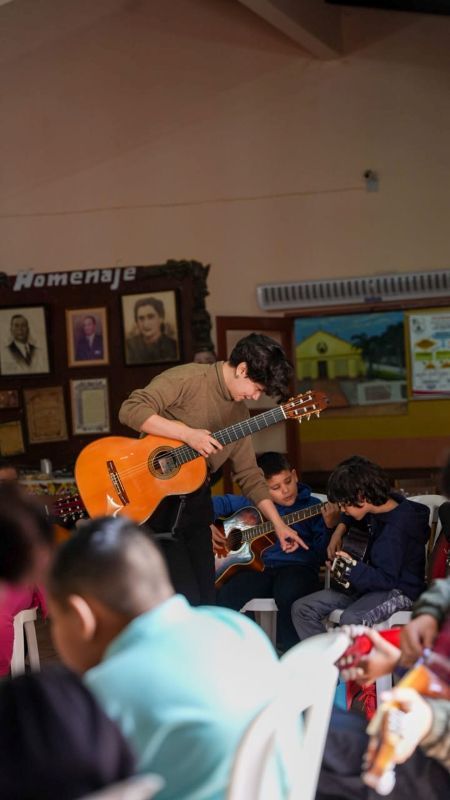
Sometimes you smile while you’re in concert, and other times you put on a serious face. Someone would say that you are taming the guitar and telling it exactly what you want it to do (as if you weren’t the one playing it). What’s going on inside you at that moment?
Very funny question. It amuses me because, most of these gestures are completely unconscious. I think they stem from the intention I put into performing. When working on a piece, I can’t help but construct a meaning, imagining scenes, as if it were an unfolding story.
So, when I play, it’s like weaving together each part of that narrative, and that’s where the smiles or angry faces emerge (haha).
In more intimate concerts, I sometimes invite the audience to imagine their own story while listening, and if they’re up for it, to share it with me afterwards. I’m always curious to know where the music takes each person.
Likewise, I confess that when it’s a piece where I’m not yet very confident on stage, it’s hard for me to relax. So letting the story flow gets more difficult for me. However, it’s always the point I long to reach.
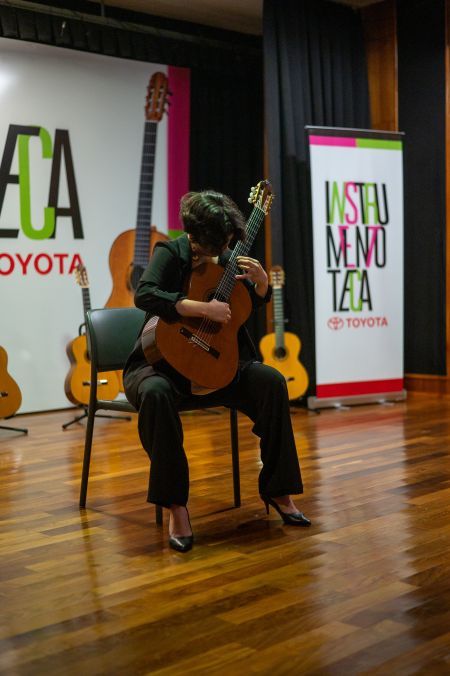
When you step onto the stage, I see a young woman with extreme sensitivity and an innate ability to make the notes flow, as if dictated by the muses. However, when I see you step onto the stage, I see a woman who is not only brave but also extremely powerful. Is it contradictory to be sensitive and have that overwhelming strength you possess?
I think it’s not a contradiction, but a necessity. Art moves us through sensitivity, which coexists and is enhanced alongside strength. Sensitivity is often associated with weakness, but for me it’s a profound capacity for connection, listening, and empathy; a very powerful way of inhabiting the world.
On stage, that sensitivity allows me to open up, perform honestly, and communicate something authentic. Doing so with conviction and firmness is also a form of resilience and a reminder that I can do it.
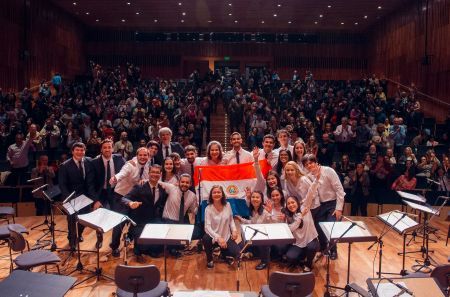
Future projects. After the trilogy you’re working on, what’s the next step? How do you plan to reach the next level?
I’d love to continue my musical development, whether academically or through the experiences that life and the artistic path offer. The next step is a trip to England, where for the first time I’ll have the opportunity to live within the European guitar scene for 45 days.
It’s an experience that excites me a lot and I’m very curious about what’s going to happen. I’m intrigued to think about what new learning, ideas, or places it will lead me to. I’m not yet sure what the “next level” will be for me, but I am clear that each step will be guided by the conviction to do things the way I feel them.
Micaela Núñez on the couch:
What is the most difficult piece you’ve ever played: Sonata Op. 47 – Ginastera.
What would you say to someone who wants to achieve excellence on the guitar:
Perseverance and curiosity are the best tools. (From me, for me.)
The phrase that helps you move forward professionally and who said it:
“You have nothing to lose by trying.” My mom says it every time she sees me hesitant about a decision that poses major challenges.
Your worst flaw: I’m a bit indecisive about things I could resolve more quickly.
Your greatest virtue: Self-confidence.
A book that has left its mark on you: Man’s Search for Meaning – Viktor Frankl.
Don’t miss Micaela Núñez’s next concert at the Ycua Bolaños Memorial on July 17th at 8:30 p.m. Check out the flyer on the cultural agenda of How to love Paraguay